
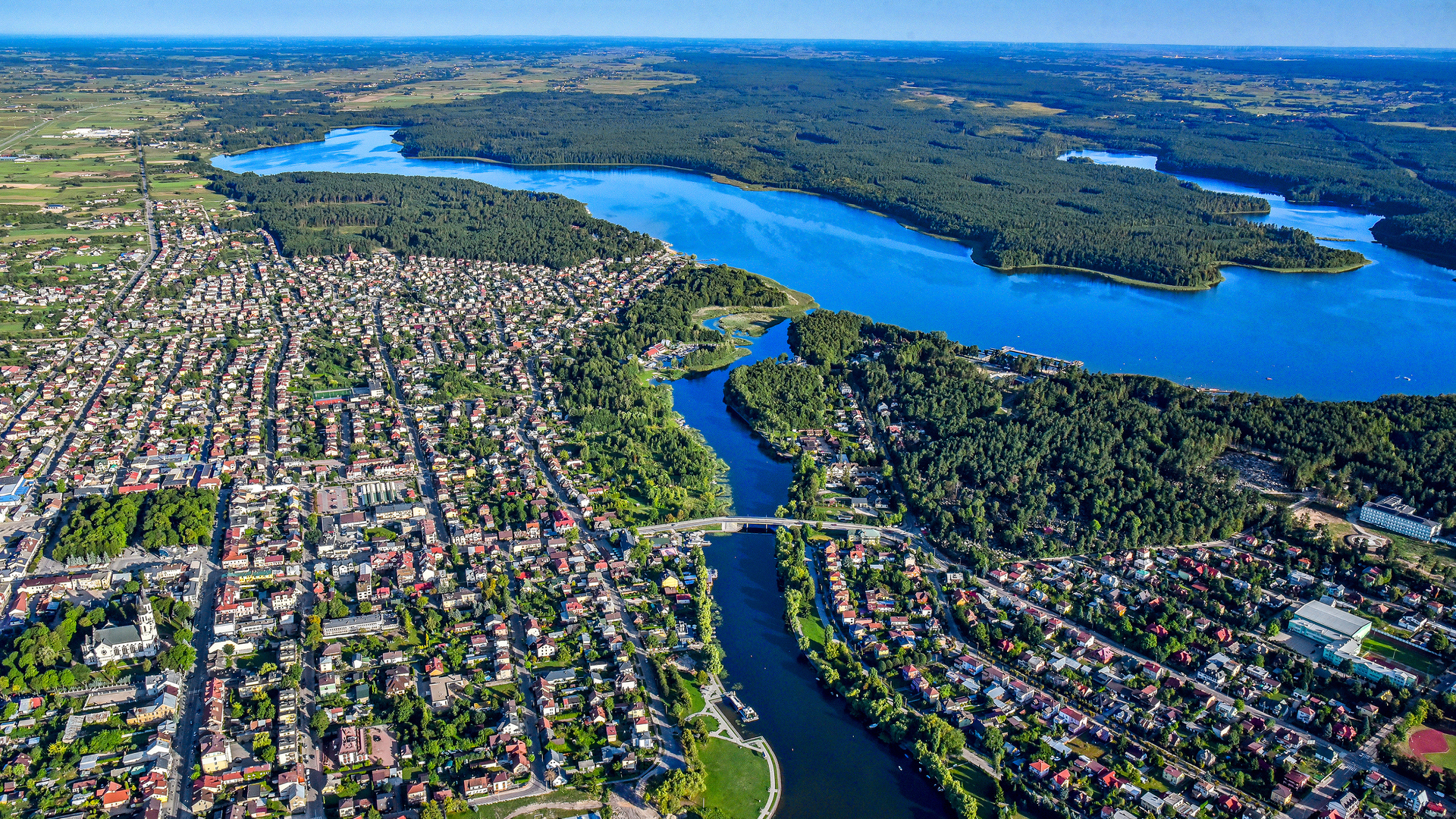
Augustów - Royal City
When in Augustów, it is worth learning about the history of its founding and visiting the most interesting places.
Legends surround the city's creation, one of which refers to the meetings of King Sigismund Augustus and Barbara Radziwiłł in the forested wilderness by the Netta River. To commemorate these encounters, the king ordered the founding of a town named after him. Historically, the first mentions of a settlement by the Netta date back to 1496. King Sigismund Augustus granted Magdeburg city rights in 1557, and on the 450th anniversary of the city, a Column of King Sigismund Augustus was erected in the center. It was built
at the initiative of the citizens of Augustów as a tribute to the founder.
It is worth starting a tour of the city by heading left from the hotel along the promenade by Lake Necko. Along the way, we pass a water ski lift, a rope park, the city amphitheater, the radio Trójka pier, and then strolling along the boulevards by the Netta River, we reach the city center. Passing Mostowa Street, one can take a souvenir photo on the bench with the famous Beata from Janusz Laskowski's song "Seven Girls from Albatros."
The central point of the city is the Market Square of Sigismund Augustus, which was laid out in 1550 by the builder of royal forts, Job Praetfues. The tenement houses around the square mainly date from the turn of the 19th and 20th centuries, and in its heart is a park from 1847, formerly called the Saxon Garden. The oldest brick building in the city is the tenement house at Sigismund Augustus Market 28, built in 1800, where on December 8, 1812, Napoleon Bonaparte stayed while returning from his failed conquest of Russia. The Old Post Office along with the park also has an interesting history according to a typical design by Henryk Marconi from 1829. Originally, there was a change station for sixteen horses, an expedition office, and guest rooms where, among others, Tsar Nicholas I and Grand Duke Constantine stayed.
During a stay in Augustów, it is worth visiting the Augustów Canal Museum located in the historic 19th-century Prądzyński manor. In addition to exhibits about the construction history of the canal, the museum houses numerous notes of General Ignacy Prądzyński and documents signed by King Stanisław August Poniatowski. For those interested in the history of this area, we recommend visiting the Augustów Land Museum, where exhibits related to agriculture, pottery, and fishing as well as cultural and ethnographic exhibitions can be found. Military enthusiasts will certainly be interested in the Memorial Room of the 1st Krechowce Uhlan Regiment, located in the tower of the Church of Our Lady of Częstochowa, near the hotel. It can be visited upon prior arrangement, and the exhibition presents uniforms, photos, documents, decorations, and elements of soldier equipment.
Augustów is not only the water capital of northeastern Poland but also a city with a rich and interesting history. In the interwar period, Augustów was Poland's most famous resort. At that time, the political and military elites of the Second Polish Republic vacationed here, including President Ignacy Mościcki, Minister Józef Beck, and Marshal Edward Rydz-Śmigły. Unfortunately, near the end of World War II, the city was in the frontline zone, which caused destruction to up to 70% of the city's buildings.

Relax Surrounded by Nature
ANDRZEJKOWA NIGHT OF HITS
Gingerbread-Scented Santa Weekend
Family Christmas
IN THE SECRET GARDEN New Year’s Eve 26/27
Winter holidays FIRST MINUTE
Comfortable Business Trip
Weekend for two Touch of nature and relaxation
SPA with a friend