
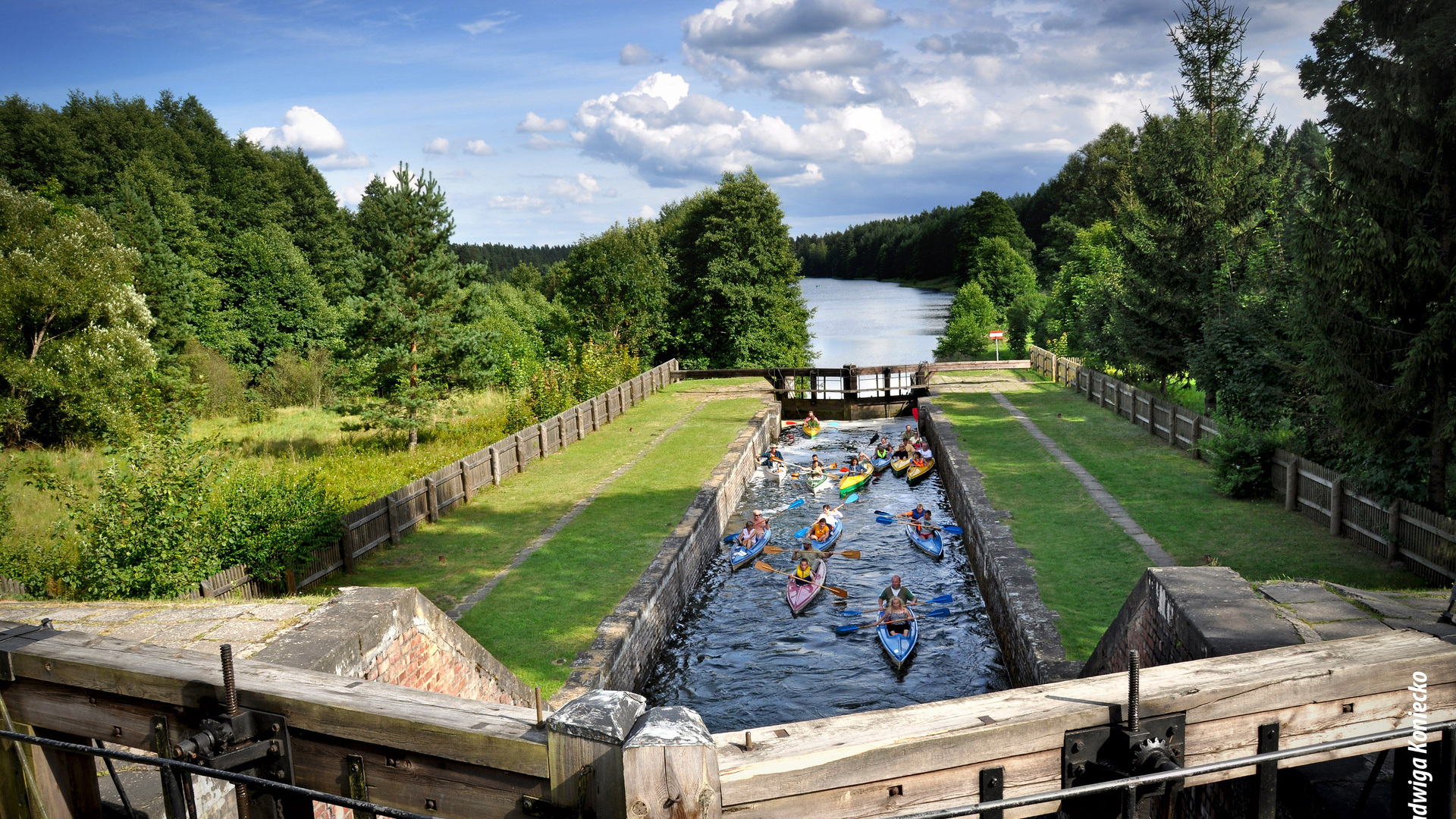
Augustów Canal
The Augustów Canal is a unique European water construction work from the first half of the 19th century. It connects the tributaries of the Vistula – the Narew and Biebrza with the Niemen to bypass Prussian territory. The reason for its construction was the Prussian customs restrictions preventing Polish goods from being transported down the Vistula to Gdańsk. In 1823, the Polish engineer Gen. Ignacy Prądzyński started working on the Augustów Canal project, and construction began in 1824.
To equalize water level differences, the following were regulated:
- 35 km of riverbeds of the Netta and Czarna Hańcza rivers,
- over 40 km of canals were dug,
- 18 locks and 23 weirs regulating the water were built.
The stone-brick locks had a beautiful architectural design in national colors. The chambers were lined with red bricks, and the chamber crowns were white. Each lock had a stone plaque set into its wall with the construction manager's name and date – to this day, almost every lock (except Gorczyca and Niemnowo) has such plaques preserved. One lock was built in about 2 years, involving between 5,000 and 7,000 people.
The outbreak of the November Uprising interrupted construction, which was finally completed in 1838, and in 1839 navigation on the Canal was opened. This work of Polish military engineering never fulfilled its strategic function as a water route linking the Vistula with the Baltic, as Prussia abandoned imposing high customs duties on the Vistula route, and the Russians halted the construction of the Widawa Canal.
The Augustów Canal is located on the territory of Poland and Belarus (14 locks on the Polish side, 1 in the border zone, and 3 on the Belarusian side). Its total length is about 103.4 km. On the Augustów Canal route, there are 12 lakes: Mikaszówek, Mikaszewo, Krzywe, Paniewo, Orle, Gorczyckie, Staw Swoboda, Studzieniczne, Białe, Necko.
Water level differences between the individual reservoirs range from 0.8 to 9.8 m.
The greater the water difference, the more complex the locks had to be built, hence the Niemnowo lock was originally three-chambered (water level difference 7.46 m), currently it is four-chambered (max water level difference 9.8 m), and the Paniewo lock (max water level difference 6.69 m) is two-chambered. The other 16 locks are single-chambered.
Currently, the Augustów Canal is used as a picturesque water route, one of the most beautiful kayaking routes in Poland. Inland navigation ships also operate on the Augustów Canal.
In 1968, the Augustów Canal was entered in the register of monuments, and by the decision of the President of Poland in 2007, it became a Historic Monument.

Relax Surrounded by Nature
ANDRZEJKOWA NIGHT OF HITS
Gingerbread-Scented Santa Weekend
Family Christmas
IN THE SECRET GARDEN New Year’s Eve 26/27
Winter holidays FIRST MINUTE
Comfortable Business Trip
Weekend for two Touch of nature and relaxation
SPA with a friend