
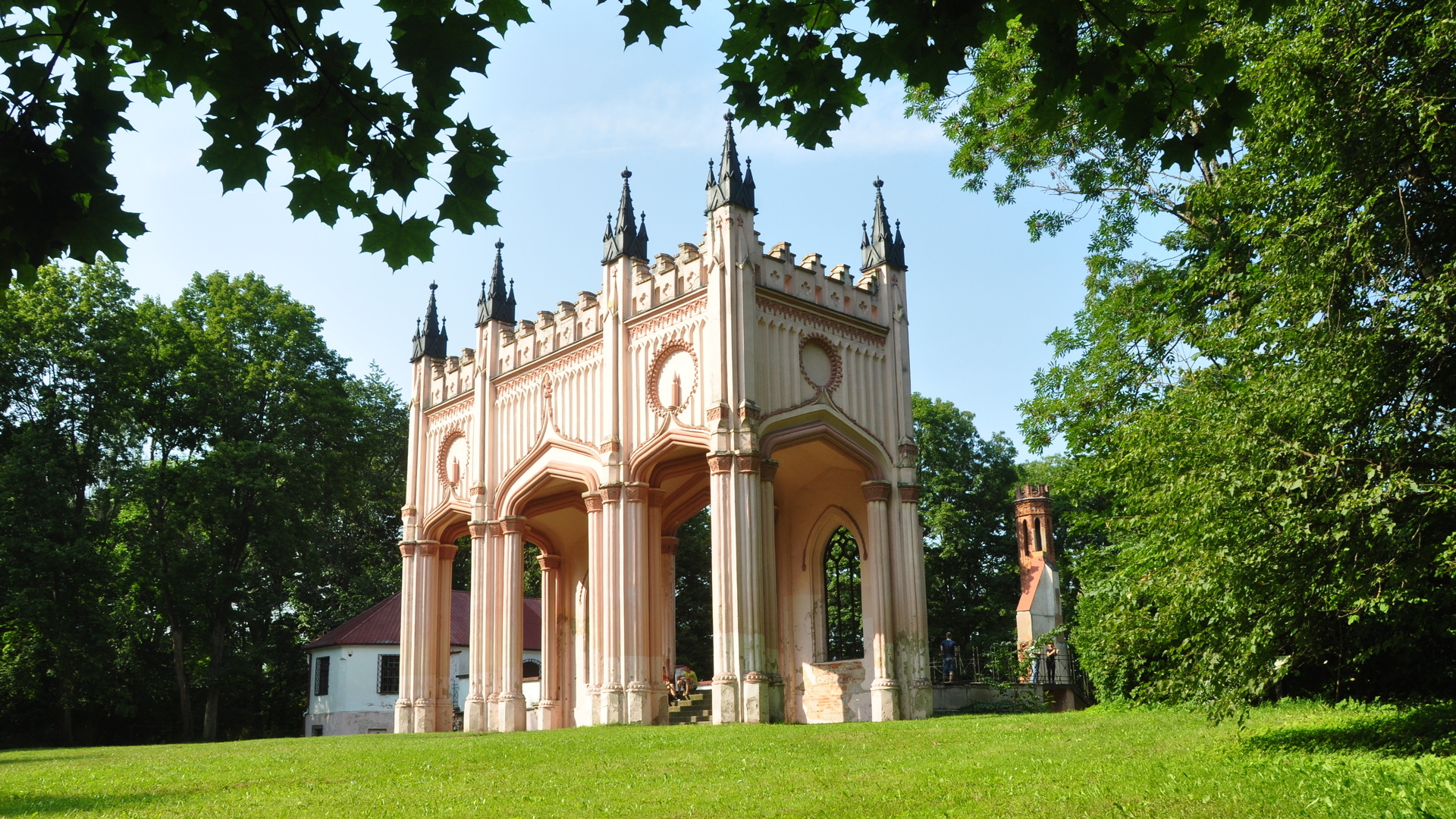
Dowspuda - Paca Palace
The saying "Worth Pac's palace, and Pac's palace" is connected to a once luxurious palace located just about 20 km from Augustów in the town of Dowspuda. There, on the banks of the Rospuda River among park trees, lie the ruins of the first neo-Gothic palace in the pure English Tudor style in the Polish lands.
It was built between 1820 and 1827 by Ludwik Michał Pac, one of the richest men in the then Polish lands. The palace was designed by Italian architect Piotr Bosio, who also initially managed the construction work, and the work was completed by the famous Henryk Marconi. The palace was richly furnished with works of art, polychromes, frescoes, and sculptures.
The figure of Ludwik Michał Pac was probably the model for the character of the Count in "Pan Tadeusz" by Adam Mickiewicz. He was a very enlightened man, devoted to his homeland, and participated in many battles on various fronts across Europe. Legend has it that while fighting Napoleon near Moscow he saved his life, and after the final defeat he went to England, where he observed how British farmers managed their estates. He transferred their experience to his own properties in Poland. After the November Uprising collapsed, the Tsarist government confiscated his assets, and Pac escaped from the besieged Dowspuda through a secret underground tunnel, which according to legend led all the way to Lake Wigry and whose ceiling was lined with glass plates allowing the observation of life unfolding at the bottom of the lake. Michał Pac died in exile in Turkey, and his palace, passing into different hands, unfortunately fell into ruin.
Today we can only see a few fragments such as the restored portico, one of the corner towers of the main body called the "stork tower," a two-story basement, and part of the palace foundations. Around the estate stretches a 13-hectare park with many trees planted by Ludwik Michał Pac's gardeners. It is worth taking a walk along the educational path "Park in Dowspuda – nature and history," which provides a moment of respite from the city noise, among the birdsong and rustling trees of the former palace park.

Relax Surrounded by Nature
ANDRZEJKOWA NIGHT OF HITS
Gingerbread-Scented Santa Weekend
Family Christmas
IN THE SECRET GARDEN New Year’s Eve 26/27
Winter holidays FIRST MINUTE
Comfortable Business Trip
Weekend for two Touch of nature and relaxation
SPA with a friend